
By The Falcon Consulting Group
The author has supported federal white collar fraud investigations and expert witness engagements across multiple U.S. Attorney’s Office matters, including procurement fraud cases reviewed by federal Inspectors General.
Counsel frequently retain a financial or investigative expert early in a matter without deciding, formally and in writing, whether that person is a consulting expert or a testifying expert. That omission is not a paperwork technicality. It determines whether the expert’s draft reports, preliminary findings, and communications with counsel are discoverable by the other side.
Most conversations about litigation experts focus on qualifications: credentials, courtroom presence, survivability under Daubert. Those matter enormously, but only once an expert is designated to testify. The more consequential decision usually happens earlier and gets less attention. It is whether the expert is retained to testify at all, or to advise counsel confidentially while someone else, or no one, takes the stand.
Get this wrong and a company can find itself producing an investigator’s early, unfiltered theories of the case to opposing counsel, handed over as an exhibit at exactly the moment they are least favorable.
What Is the Difference Between a Consulting Expert and a Testifying Expert?
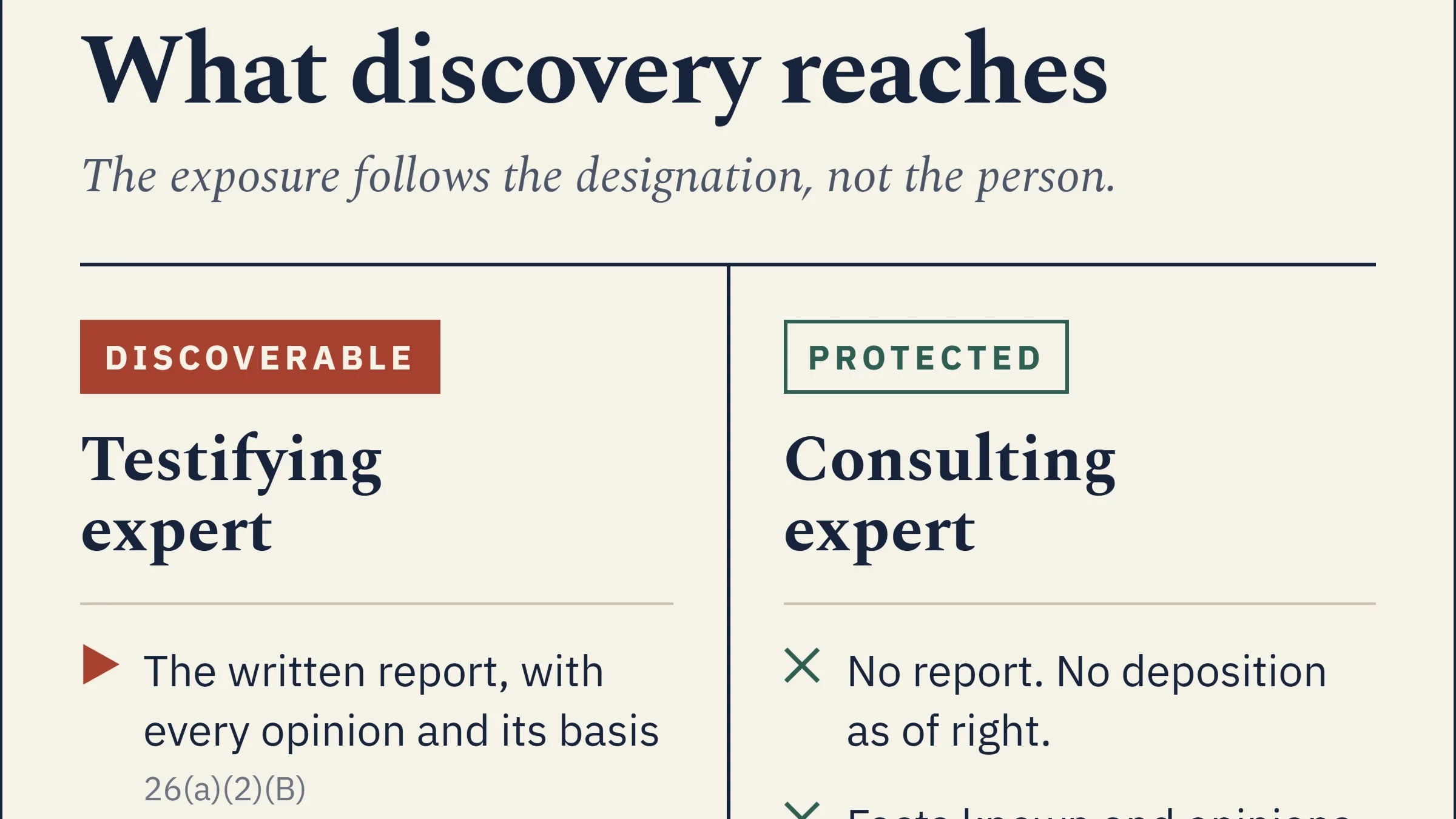
A testifying expert is designated to offer opinions at trial, and their opinions and the facts and data they considered are generally discoverable. A consulting expert advises counsel without testifying, and their work is generally protected from discovery absent exceptional circumstances. Federal Rule of Civil Procedure 26(b)(4) treats these as fundamentally different categories, and most state rules track it closely.
The difference is not seniority, credentials, or fee. Two forensic accountants with identical qualifications can occupy the two roles on the same matter and face completely different discovery exposure, because the exposure follows the designation rather than the person.
The Testifying Expert
Anyone designated to offer opinions at trial must produce a written report under Rule 26(a)(2)(B) disclosing all opinions, the basis and reasons for them, and the facts or data considered. Once designated, that expert is subject to deposition, and a wide range of materials becomes fair game for the other side to probe.
Cornell’s summary of expert witness report requirements makes the practical consequence plain: an opinion not stated in the report generally cannot be offered at trial. The report is not a formality that follows the analysis. It is the boundary of what the expert will be permitted to say.
The Consulting Expert
An expert retained only to advise counsel, evaluate the case internally, or help shape strategy, without any intention of putting them on the stand, is generally shielded from discovery under Rule 26(b)(4)(D). Opposing counsel typically cannot depose them, obtain their reports, or compel disclosure of their opinions absent exceptional circumstances, such as a showing that no comparable expert is available on the relevant subject matter.
Cornell’s entry on non-testifying expert witnesses frames the standard as impracticability: the party seeking discovery must show it cannot obtain facts or opinions on the same subject by other means. That is a demanding threshold, and it is why the consulting designation carries real protective value rather than nominal value.
Why the Distinction Exists
The practical effect is that a consulting expert can test theories, flag weaknesses in the client’s position, and produce blunt preliminary work product that would be damaging if it ever reached the jury, precisely because it is protected from ever getting there.
That candor has a purpose. Counsel who cannot get an unvarnished assessment of their own case will make settlement, charging, and trial decisions on incomplete information. The rule exists to make honest internal analysis possible, and the protection only functions if the engagement is structured to claim it.
Where Does This Protection Actually Get Lost?
The protection is not automatic. It depends on how the engagement is structured and documented from day one, not on how it is characterized after a dispute arises. In practice it erodes in a handful of predictable ways.
No Engagement Letter Defining the Role
If nothing in writing establishes that an expert was retained for consulting purposes only, counsel is arguing after the fact, usually in front of a judge who has already seen the expert’s unflattering preliminary notes.
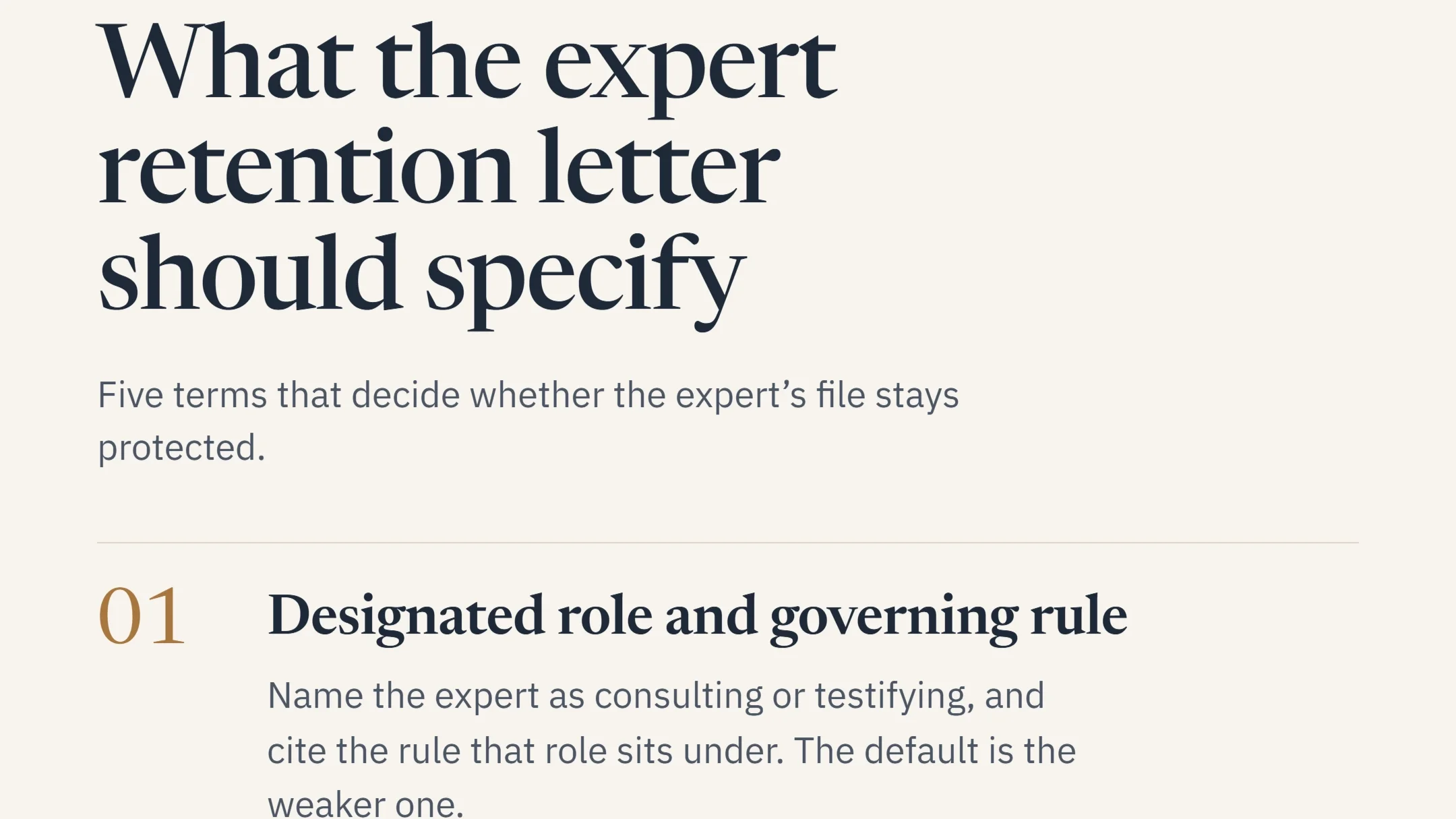
The retention letter, not the expert’s resume, is where most of this risk is created or avoided. It should name the rule the engagement is made under, describe the scope, and state who the expert reports to. A one-line reference to services rendered does none of that work.
Converting a Consulting Expert Into a Testifying One
This happens constantly. An expert does strong early work, and counsel decides mid-case to designate them to testify. That decision generally waives protection over that expert’s prior consulting work product, and courts have been inconsistent about how far back the waiver reaches.
Treat conversion as a one-way door, not a formality. The question is not whether the eventual testimony would be valuable. It is whether the specific consulting work already generated, including the early theories that did not survive, can withstand being read aloud on cross.
Misreading the 2010 Amendment Carve-Outs
The 2010 amendments to Rule 26 extended work-product protection to draft expert reports and most attorney-expert communications, but with named exceptions. Rule 26(b)(4)(C) protects those communications except to the extent they relate to compensation for the expert’s study or testimony, identify facts or data that counsel provided and the expert considered, or identify assumptions that counsel provided and the expert relied on.
Counsel who assume the 2010 amendments made all attorney-expert correspondence privileged are wrong, and that misunderstanding shows up in discovery disputes constantly. The carve-outs are narrow on paper and wide in practice, because most substantive correspondence with a testifying expert conveys either a fact, a data set, or an assumption.
Blended Roles on a Single Engagement
An expert who advises on strategy and eventually testifies about a narrower issue creates a fact pattern courts have to sort through case by case. Did protected consulting work bleed into the testifying opinion, or stay genuinely separate?
The safer structure, where the matter allows it, is two experts: one who consults, one who testifies, without one becoming the other. The cost of a second engagement is almost always lower than the cost of litigating a waiver question, and considerably lower than the cost of losing it.
Does the Same Rule Apply in New Jersey State Court?
New Jersey applies a comparable framework under Court Rule 4:10-2(d), which permits discovery of a non-testifying expert only on a showing of exceptional circumstances under which it is impractical to obtain facts or opinions on the same subject by other means. The threshold language mirrors the federal standard closely.
Two differences are worth flagging for matters in New Jersey state court. Discovery of attorney-expert communications is limited to the facts and data considered by the expert in rendering the report, which is a differently worded boundary than the federal carve-outs. And New Jersey courts have addressed the situation where a party seeks to use an expert originally consulted by an adversary, treating exceptional circumstances as the governing test there as well.
For any matter that could proceed in either forum, structure the engagement to satisfy the stricter reading rather than assuming the two regimes are interchangeable. Jurisdictional variation on this point is a question for counsel, and it belongs in the retention letter rather than in a later motion.
What About Privilege, Rather Than Work Product?
Work product and attorney-client privilege are separate protections, and financial experts sit at an intersection where both can apply.
Where an accountant is engaged by counsel to help counsel understand financial information in order to render legal advice, courts have extended attorney-client privilege to that engagement, following the reasoning of United States v. Kovel. The engagement has to run through counsel and exist to support legal advice rather than ordinary business or accounting services. An accountant retained directly by the company, doing the same analysis, generally does not get the same protection.
This is the same structural point that governs whether an internal financial review can be conducted under privilege at all, which is why the decision to escalate a matter from internal audit to a forensic engagement should involve counsel before the work begins rather than after findings already exist in a file.
How Should Counsel Structure the Engagement?
Decide the role before the engagement begins, not during it. The retention letter should state plainly whether the expert is retained under Rule 26(b)(4)(D) as a non-testifying consultant, or as a testifying expert subject to Rule 26(a)(2)(B) disclosure. Silence gets read against the party claiming protection.
- Be deliberate about what you put in writing to a testifying expert. Facts, data, and assumptions provided to a testifying expert are discoverable regardless of how they are communicated. Draft opinions and mental impressions generally are not, but that line is hard to apply consistently as work product accumulates, and it is far easier to draw clearly at the start of an engagement than to reconstruct after a report already exists.
- Treat conversion decisions as strategic, not administrative. If a consulting expert’s findings are strong enough that counsel wants them in front of the jury, that decision should weigh the specific consulting work product likely to be exposed, not just the value of the expert’s eventual testimony.
- Match the investigator or accountant to the intended role from the start. An expert who understands whether they are building a confidential internal case assessment or a courtroom-ready opinion works differently: what they document, how they phrase preliminary findings, what stays in a memo versus what goes in a formal report.
- Route the engagement through counsel and keep it there. An expert retained by the client and later reassigned to counsel is a materially weaker position than one engaged by counsel at the outset, both for work product and for privilege.
What the Expert Should Be Doing Differently in Each Role
A consulting expert is being paid for candor. Preliminary hypotheses, adverse findings, and the theory that collapsed in week two all have value to counsel, and the engagement is structured so that value can be delivered without creating exhibits.
A testifying expert is being paid for a defensible opinion. Every working file, every assumption, and every version of the analysis exists in a context where it may be examined. Under the December 2023 amendment to Federal Rule of Evidence 702, the proponent bears the burden of establishing admissibility by a preponderance, which raises the cost of a loosely documented methodology considerably.
Those are different jobs, and an expert who does not know which one they hold will do neither well. The credential set that makes an expert persuasive on the stand is a separate question, covered in our post on what makes a credible expert witness in a white collar fraud case.
Frequently Asked Questions
What is the difference between a consulting expert and a testifying expert?
A testifying expert is designated to give opinions at trial and must produce a report under Rule 26(a)(2)(B) disclosing their opinions, the basis for them, and the facts or data considered. A consulting expert advises counsel without testifying and is generally protected from discovery under Rule 26(b)(4)(D) absent a showing of exceptional circumstances. The same professional can serve in either role. The discovery exposure attaches to the designation.
Are a consulting expert’s reports discoverable?
Generally no. Under Rule 26(b)(4)(D), a party may not discover facts known or opinions held by a non-testifying expert except as provided for court-ordered examinations or on a showing of exceptional circumstances under which it is impracticable to obtain facts or opinions on the same subject by other means. That is a difficult showing, which is what makes the consulting designation meaningful rather than nominal.
Can a consulting expert later testify?
Yes, but the conversion generally waives work-product protection over that expert’s prior consulting work, and courts have not been consistent about how far back the waiver reaches. Counsel should assume the early material becomes available and decide whether it can withstand cross-examination before making the designation, rather than after.
Did the 2010 amendments make all attorney-expert communications privileged?
No. Rule 26(b)(4)(C) protects most communications between counsel and a testifying expert, with three named exceptions: communications relating to the expert’s compensation, communications identifying facts or data counsel provided that the expert considered, and communications identifying assumptions counsel provided that the expert relied on. Draft reports are separately protected under Rule 26(b)(4)(B).
Should one expert consult and testify on the same matter?
Where the matter allows it, use two. A blended role creates a case-by-case question about whether protected consulting work influenced the testifying opinion, and answering that question costs more than a second engagement. Where budget or subject-matter scarcity makes a single expert unavoidable, define the boundary in writing at the outset and maintain it in practice.
Is a forensic accountant retained by counsel covered by attorney-client privilege?
Potentially, where the accountant is engaged by counsel to help counsel understand financial information in order to give legal advice. That is the Kovel line of reasoning. The engagement has to run through counsel and support legal advice rather than ordinary accounting or business needs. An accountant retained directly by the company performing the same work generally does not receive the same protection.
The Bottom Line
The qualifications conversation is the one everyone has. The designation conversation is the one that determines what the other side gets to read.
Both belong at the start of the engagement, in writing, before an expert has generated a single preliminary theory. A retention letter that names the role, the rule, and the reporting line costs nothing to draft and resolves in advance a question that is expensive to litigate and worse to lose.
Key Takeaways
- The retention letter is the control. Name the role and the governing rule before any analysis begins, because silence is resolved against the party claiming protection.
- Conversion is a waiver decision, not an administrative one. Weigh the specific prior work product that would be exposed, not just the value of the testimony.
- The 2010 carve-outs are narrow on paper and wide in practice. Most substantive correspondence with a testifying expert conveys a fact, a data set, or an assumption.
- Two experts beat one blended role wherever the matter allows it. The second engagement costs less than litigating a waiver question.
- New Jersey Court Rule 4:10-2(d) applies a comparable exceptional-circumstances threshold, with its own wording on attorney-expert communications. Structure to the stricter reading when the forum is uncertain.
- Work product and privilege are separate protections. An accountant engaged by counsel to support legal advice may reach both. One retained directly by the company usually reaches neither.
Work With Falcon Consulting Group
Falcon Consulting Group provides both consulting and testifying experts for financial fraud, white collar, and complex civil litigation matters, with associates experienced in structuring engagements to preserve work-product protection from day one.
Our litigation support and investigative services are delivered by former federal agents and CPA and CFE certified forensic accountants available for confidential case assessment or courtroom testimony. We take the designation question up before the engagement letter is signed, not after a discovery dispute makes it urgent.
If you are retaining a financial expert on a live matter, contact us before the scope is set.
About Falcon Consulting Group
Falcon Consulting Group is a corporate investigations and compliance advisory firm whose associates include former federal and state law enforcement personnel, former Inspector General staff, CPAs, Certified Fraud Examiners, and CAMS certified professionals. The firm supports counsel and corporate clients across forensic accounting, white collar investigations, litigation support, and regulatory compliance. Learn more about the Falcon team.