
By The Falcon Consulting Group
Most internal investigations eventually come down to conversations. Documents show what happened. Interviews explain why, who knew, and who decided.
Those conversations are also where investigations most often go wrong. An employee walks out believing the company’s lawyer was protecting them. A manager’s interview notes end up as an exhibit. A supervisor sits in on an interview and the privilege argument gets harder.
The rules here are not new. They date to a 1981 Supreme Court decision. But they are routinely misapplied by people who have not run many investigations, and the mistakes are hard to undo.
This post covers how employee interviews should work. For what needs to happen before the first interview, see our post on the first 72 hours of an internal investigation.
Who Does the Privilege Belong To?
The company. In Upjohn Co. v. United States, 449 U.S. 383 (1981), the Supreme Court held that communications between a company’s lawyers and its employees, made at the direction of management to secure legal advice for the company, can be protected by the attorney-client privilege. That holding is what makes privileged internal investigations possible.
It also creates the problem. The privilege protects the company’s communications, and only the company can decide whether to waive it. If the company later decides to cooperate with prosecutors or regulators, it can share what the employee said. The employee has no say.
Employees frequently do not understand this. They hear “I’m the company’s lawyer, and this is confidential” and conclude that the lawyer is on their side. That misunderstanding is what the Upjohn warning is meant to prevent.
What Is an Upjohn Warning?
An Upjohn warning, sometimes called a corporate Miranda warning, is the explanation counsel gives an employee before an interview begins. It makes the relationship clear before the employee says anything.
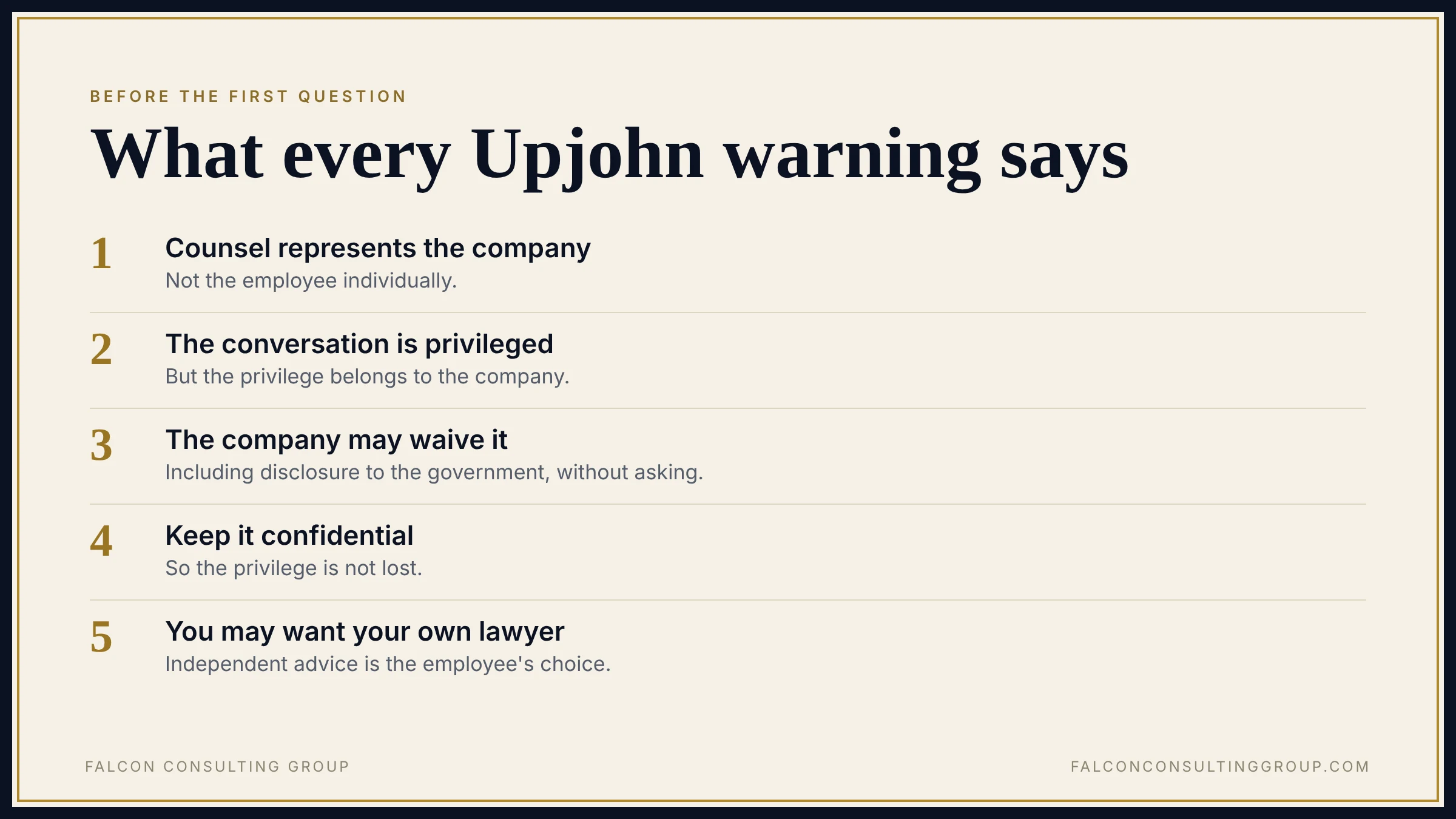
In 2009 an ABA White Collar Crime Committee working group published recommended best practices for Upjohn warnings that remain the standard reference, and practitioners continue to stress why the warning matters to the employee in the chair. In substance, the warning should cover five points:
- Counsel represents the company, not the employee individually.
- The conversation is privileged, but the privilege belongs to the company.
- The company may choose to waive the privilege and disclose what the employee says to third parties, including the government, without asking the employee.
- The employee should keep the conversation confidential so that the privilege is not lost.
- The employee may want their own lawyer, and is free to consult one.
The warning should be given at the start, in plain language, before any substantive questions. It should be documented in the interview memo, including the employee’s acknowledgment.
What Happens When the Warning Is Unclear?
The company’s privilege can be challenged, and the employee may claim they believed they had a personal attorney. The best-known example is United States v. Ruehle (9th Cir. 2009), in which a former CFO argued that statements he made to company counsel during an internal investigation were protected by his own privilege. The court rejected that argument, but only after years of litigation about what he was told and what he understood.
Cases like that are expensive even when the company wins. A clear warning, clearly documented, prevents most of them.
A vague warning also creates a different risk: the lawyer may inadvertently form an attorney-client relationship with the employee. If the employee’s interests later diverge from the company’s, which happens often, counsel can face a conflict that forces them off the matter.
Who Should Be in the Room?
Two interviewers, and nobody else from the business. One person asks questions. The other takes notes and serves as a witness to what was said, including that the Upjohn warning was given.
At least one interviewer should be counsel, or the investigator should be working at counsel’s direction. Forensic accountants and former investigators are often the right people to ask the questions in a financial matter, because they know which answers to test against the records.
The employee’s supervisor should not attend. Neither should a human resources representative unless counsel has a specific reason. Each additional person creates a risk to privilege and makes the employee less likely to speak candidly.
Unionized employees
Employees covered by a collective bargaining agreement generally have the right to have a union representative present at an investigatory interview they reasonably believe could lead to discipline, under what are commonly called Weingarten rights. If the employee asks for a representative, the interview should pause until counsel decides how to proceed.
In What Order Should Employees Be Interviewed?
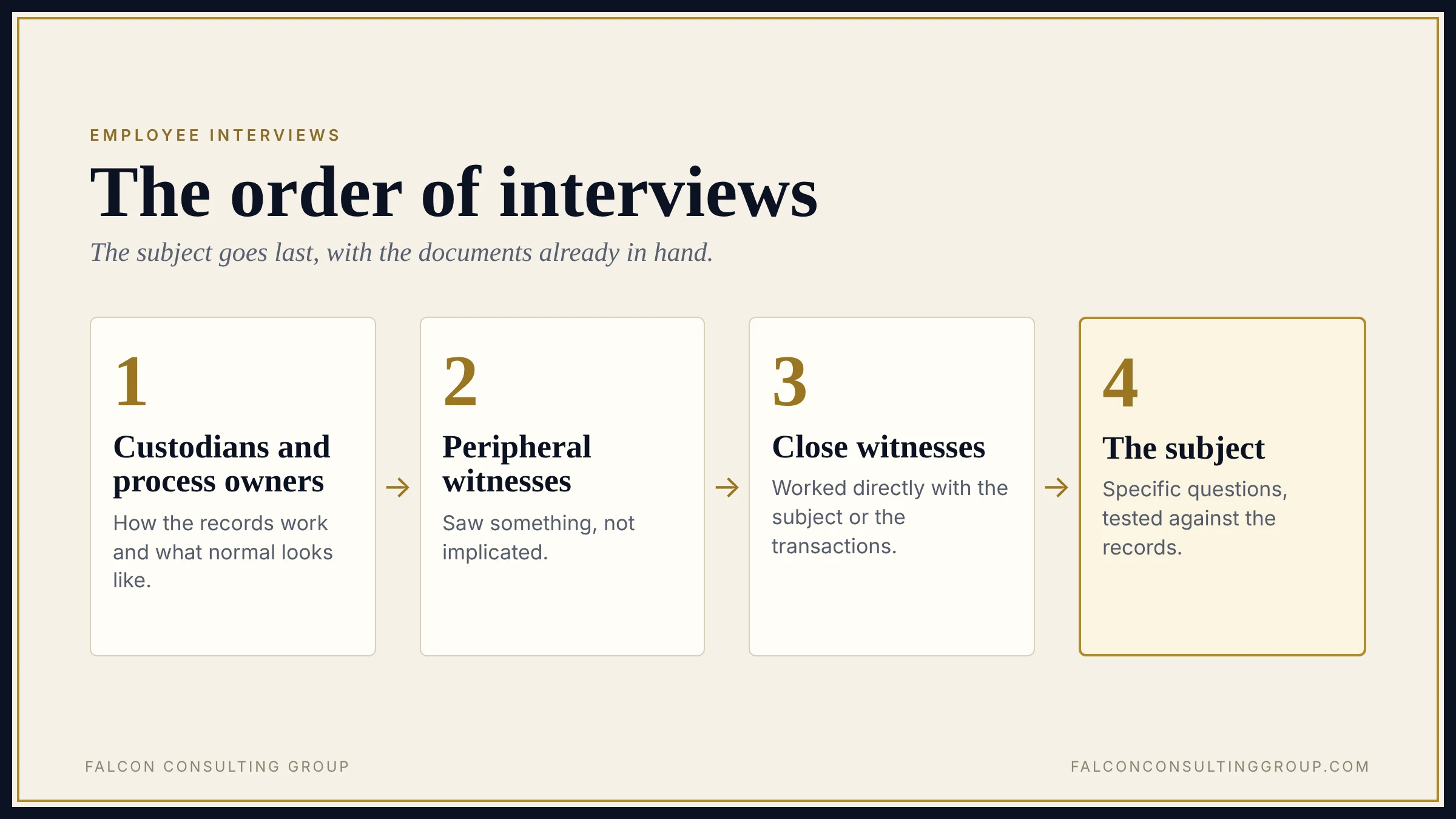
Start with people who know the documents. End with the subject. Interview order is one of the most important decisions in an investigation, and one of the most commonly rushed.
The usual sequence:
- Document custodians and process owners who can explain how the records work and what normal looks like.
- Peripheral witnesses who saw something but are not implicated.
- Closer witnesses who worked directly with the subject or the transactions.
- The subject, last, after the investigators know what the records show and what other witnesses have said.
Interviewing the subject early gives them a preview of the investigation and an opportunity to align their story or their records. Interviewing them last allows the investigators to ask specific questions with the documents in hand.
How Should the Interview Be Documented?
With a memorandum that reflects counsel’s mental impressions, not a transcript. This is a work-product question. Federal Rule of Civil Procedure 26(b)(3) gives the strongest protection to an attorney’s mental impressions, conclusions, opinions, and legal theories. A verbatim transcript or recording looks like a witness statement, and witness statements are easier for an adversary to obtain. A memo that summarizes the conversation and reflects counsel’s analysis and impressions is closer to the core of what the work-product doctrine protects.
Practical rules:
- Do not record the interview unless counsel has decided that a recording is necessary.
- Write the memo promptly, while the details are fresh.
- Include a statement that the memo reflects counsel’s impressions and is not a verbatim account.
- Record that the Upjohn warning was given and acknowledged.
- Keep the memo in counsel’s files, not in the HR system or a shared drive.
The D.C. Circuit’s decision in In re Kellogg Brown & Root (2014) confirmed that internal investigation materials can remain privileged even where the investigation was also required by company policy or regulation, so long as obtaining legal advice was one of the significant purposes. Documentation that shows counsel directing the work helps make that showing.
What About the Risk of Obstruction?
Employees sometimes respond to an interview by going back to their desk and deleting things. That conduct can be a federal crime. 18 U.S.C. § 1519 makes it a felony to destroy or alter records with the intent to obstruct a federal investigation, and courts have read it to reach conduct that anticipates an investigation that has not started yet.
The company’s best protection is to have preserved the records before any interview took place. Some counsel also remind employees during the interview that relevant documents must be preserved. That reminder should be worded carefully and is a judgment call for counsel in each matter.
Frequently Asked Questions
What is an Upjohn warning?
It is the explanation company counsel gives an employee before an interview: counsel represents the company, the conversation is privileged but the privilege belongs to the company, the company may waive it and share what is said, the employee should keep it confidential, and the employee may consult their own lawyer.
Does the employee have to answer questions?
A private employer can generally require cooperation as a condition of employment, and refusing to cooperate can be grounds for discipline. That is different from a government interview, and the employee may want independent advice. This is a question for counsel in each case.
Can the company share what the employee said with the government?
Yes. The privilege belongs to the company. If the company decides to cooperate with an investigation, it can waive the privilege and disclose interview content, which is exactly why the warning is given.
Should employee interviews be recorded?
Usually not. A recording or verbatim transcript looks like a witness statement and may be easier for an adversary to obtain. A memo reflecting counsel’s impressions is generally better protected.
Can HR conduct the interviews instead of counsel?
HR can conduct routine workplace inquiries, but HR-led interviews are unlikely to be privileged. Where the matter could involve litigation, regulators, or prosecution, interviews should be conducted by or at the direction of counsel.
Who should interview the person suspected of wrongdoing?
The most experienced interviewer on the team, last, after the documents and other witnesses have been reviewed. In financial matters, that is often a forensic accountant or former investigator working at counsel’s direction.
The Bottom Line
The interview is where an investigation gets its explanations, and where it is easiest to create problems the company will be litigating years later.
Warn clearly. Interview in the right order. Keep the room small. Document impressions, not transcripts.
Key Takeaways
- The privilege in an internal investigation belongs to the company. The employee cannot assert it or block its waiver.
- Every interview starts with an Upjohn warning, given in plain language and documented in the memo.
- Two interviewers, no supervisors, and counsel directing the work.
- Interview custodians and peripheral witnesses first, and the subject last.
- Memos should capture counsel’s impressions, not verbatim answers.
- Preserve records before interviews begin so that nothing can be destroyed afterward.
Work With Falcon Consulting Group
Falcon Consulting Group’s associates include former federal agents with decades of investigative interview experience, and CPA and CFE certified forensic accountants who know which answers to test against the books.
We work at the direction of counsel to plan interview sequences, prepare document-based questions, conduct or support interviews, and prepare work product that holds up. Learn more about our white collar investigation and litigation support services.
If your investigation is moving toward interviews, contact us before the first one is scheduled.
About Falcon Consulting Group
Falcon Consulting Group is a corporate investigations and compliance advisory firm whose associates include former federal and state law enforcement personnel, former Inspector General staff, CPAs, Certified Fraud Examiners, and CAMS certified professionals. The firm supports counsel and corporate clients across forensic accounting, white collar investigations, litigation support, and regulatory compliance. Learn more about the Falcon team.